

Pain is often the reason New Jersey patients finally book an appointment at Vascura Pain & Vein Clinic, but it should not be the only reason. Understanding the role of pain in varicose veins and vein disease may help you take care of yourself, whether or not your veins hurt right now.
As a board-certified physician specializing in both pain treatment and venous conditions, Dr. Glenn Babus asks this very question during consultations with every patient visiting any of the three clinics throughout Northern New Jersey. And the truth he shares about painless veins is one that many people, including general physicians, are unaware of.
Meet Dr. Glenn Babus: Your Pain Management Expert in Clifton, NJ
Glenn Babus, DO, is an expert physician board-certified in pain management and vein treatments. He runs his own practice, Vascura Pain and Vein Clinic, where he utilises state-of-the-art treatment modalities with his highly personalized touch.
Dr. Babus conducts all consultations, injections, and treatments in his Clifton-based clinic himself, providing continuity and individualized treatment at all stages. His unique background as a specialist in two fields enables him to approach every patient comprehensively, realizing the complex nature of conditions like leg pain.
Pain Is Common — But Not Universal
Clinical evidence suggests that approximately half of patients with visible varicose veins experience significant symptoms, while the other half report only mild or no discomfort. This variation exists because varicose vein pain is influenced by far more than the size of the vein alone. Venous pressure buildup, nerve sensitivity in the surrounding tissue, and the degree of inflammation within the vein wall all play a role.
A large varicose vein in one patient may cause intense daily pain that disrupts work and sleep. The same-sized vein in another patient may produce only a mild sense of heaviness by evening. Neither patient should assume their experience is the full story of their vein health.
This is why Dr. Babus performs duplex ultrasound imaging as a standard part of every vein evaluation at Vascura. Surface appearance and symptom severity often underestimate the extent of underlying venous insufficiency, a condition where damaged vein valves allow blood to pool in the legs rather than circulate efficiently back to the heart. Catching this early, before symptoms escalate, is central to Dr. Babus’s treatment philosophy.
The Varicose Vein Pain That Should Concern You
Not all leg pain points to varicose veins, and not all varicose vein-related discomfort is the same. Drawing on years of dual-specialty practice treating both pain and vein conditions throughout Northern NJ, Dr. Babus identifies several symptom patterns that are most directly linked to venous disease:
- Progressive end-of-day leg heaviness and aching that has gradually worsened over months or years
- Positional pain relief — discomfort that is clearly worse after prolonged standing and noticeably better after a night of sleep with legs elevated
- Burning, throbbing, or cramping pain that runs directly along the path of a visible vein.
- Ankle and lower leg swelling accompanied by achiness, particularly in the afternoon and evening
- Restless legs or nighttime cramping that disrupts sleep regularly
These patterns suggest venous insufficiency as the underlying driver. They warrant a formal evaluation, including duplex ultrasound to confirm the diagnosis, map the affected veins, and assess severity before recommending a treatment plan.
What makes Vascura’s approach distinctive is Dr. Babus’s dual-speciality expertise. Many patients arrive having been told their leg pain is “just arthritis” or “muscle fatigue,” when the actual cause is compromised vein function. Because Dr. Babus treats both pain and vein conditions, he is positioned to evaluate both possibilities in a single visit, a level of integrated diagnostic insight that most standalone clinics cannot offer.
Pain That Signals Something More Serious
Certain changes in the quality, location, or intensity of varicose vein symptoms require prompt evaluation, not a scheduled appointment weeks out.
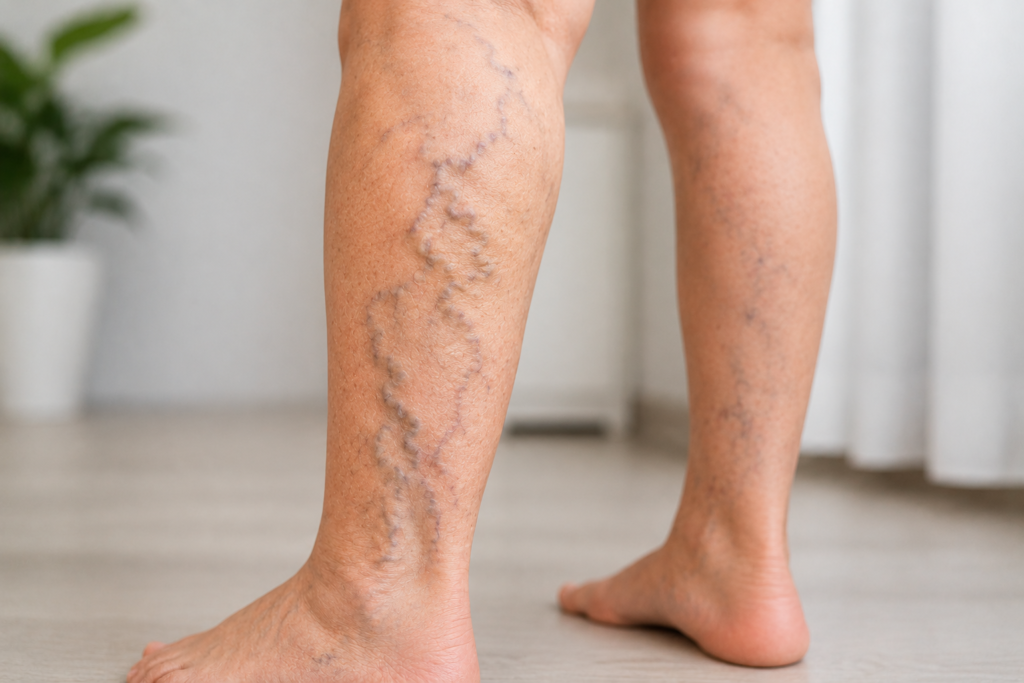
Superficial thrombophlebitis occurs when a clot develops within a surface varicose vein. The affected segment becomes suddenly hard, warm, red, and intensely painful a pattern distinctly different from the gradual aching of typical venous insufficiency. Ultrasound evaluation is required to rule out extension of the clot into the deep venous system, which would constitute a medical emergency.
Deep vein thrombosis (DVT) presents as new, severe pain in one leg, frequently accompanied by warmth, redness, and significant swelling. Deep vein thrombosis requires same-day evaluation. A portion of the clot can break free and travel to the lungs, causing a pulmonary embolism, a potentially life-threatening event. Patients with known varicose veins or a history of venous disease carry an elevated baseline risk for DVT, which is another reason Dr. Babus emphasises early evaluation rather than watchful waiting.
Take the Next Step Toward Better Care
Contact us today to learn more about our pain and vein care services and schedule your visit with our team.
Book your ConsultationWhen Varicose Veins Don’t Hurt — But Still Require Attention
For many patients suffering from varicosities that are easily seen on the legs, the absence of pain leads them to believe that nothing needs to be done until discomfort appears. This approach is highly misguided.
Venous insufficiency is a progressive disease, which means that high venous pressure eventually causes skin and subcutaneous damage of the lower leg, a process known as lipodermatosclerosis. Changes in skin color, thickness, and texture are the first symptoms. As a consequence, there is development of venous ulcers on the lower leg, which are very challenging to treat because of frequent complications like infection.
In such cases, patients need more complex and aggressive treatment, including everything from surgical interventions and wound care to advanced treatments. Although the available procedures include radiofrequency ablation, foam sclerotherapy, Varithena, and compression, the burden of disease is heavier, and recovery time and risk of recurrence are also greater.
From a practical standpoint, one can summarize the following. Absence of pain does not equate a lack of problem. At Vascura, an examination by ultrasonography will help reveal how serious the issue is.
The Case for Earlier Treatment
Many NJ patients wait until their varicose vein pain becomes severe before seeking care, but this is, paradoxically, the least optimal time to intervene. By the time pain is significant enough to be disabling, venous insufficiency has typically progressed to involve more extensive reflux, skin changes, and sometimes superficial clotting. The treatment course is longer, the number of sessions required is higher, and the likelihood of complete symptom resolution is reduced.
Patients who consult Dr. Babus when symptoms are mild or when veins are visible but not yet symptomatic typically have a wider range of treatment options available. Minimally invasive, in-office procedures performed under local anesthesia can be completed in under an hour, with most patients returning to normal activity the same day or within 24 to 48 hours. Insurance coverage for vein treatment is often available when venous insufficiency is confirmed on ultrasound, regardless of whether the primary concern is cosmetic or symptomatic.
What to Expect at Vascura Pain & Vein Clinic
One of the things you can expect at Vascura is Dr. Babus’s philosophy of treatment, which entails the fundamental belief that treating the cause of the problem is better than addressing the visible symptom. Every vein clinic patient will have his or her case analyzed through a complete physical examination and a detailed conversation regarding the patient’s symptoms. In addition, depending on what the initial analysis shows, Duplex ultrasound will be utilized to provide an accurate depiction of the venous system and determine points where reflux occurs.
Based on the above analysis, Dr. Babus will provide patients with a custom-made solution that takes into account patients’ anatomical characteristics, disease severity, their living conditions, and personal preferences. The doctor will provide a clear diagnosis and discuss all options – from conservative treatment such as compression stockings to invasive procedures including RF closure and Varithena foam. Finally, it should be noted that Vascura accepts all major health insurance providers and has several conveniently located offices in Northern New Jersey.
Conclusion
Chronic pain doesn’t need to define your existence. If you’re suffering from back pain, sciatica, knee arthritis, or neck pain, there is an effective, non-surgical approach that can help you overcome your problems with minimal medication and without any recuperation period. With Dr. Glenn Babus, you receive the benefit of a physician with an impressive credential list: he is a board-certified pain specialist who assesses each individual and determines which treatment will work for you without relying on a pre-set regimen.
Be it acute or chronic pain, there’s only one solution – seek proper medical help from a professional who will diagnose you correctly. Dr. Babus’s practice is conveniently located at 1187 Main Avenue, Suite 1D, Clifton, New Jersey. You’re welcome to visit him from anywhere in Passaic County without a referral.
Book Your Consultation at Vascura Pain & Vein Clinic →
FAQ
Q1: What is the main cause of varicose veins?
Answer: Damaged vein valves result in blood pooling in the leg veins rather than returning to the heart. Ageing, genetics, pregnancy, and prolonged standing can all contribute. Vascura is renowned for its advanced diagnostic and treatment techniques.
Q2: How do I stop varicose veins from forming?
Answer: Maintain an ideal weight, exercise regularly, avoid prolonged standing, put on compression stockings, and elevate your legs regularly. A timely assessment at Vascura can help detect venous insufficiency
Q3: Are varicose veins a worry?
Answer: While varicose veins might look like a cosmetic problem, they indicate more serious venous insufficiency. This condition can advance to skin deterioration, ulcers, and even clots without proper management. Vascura’s Dr. Babus addresses both cosmetic and health issues effectively.
Q4: What is the best treatment for varicose veins?
Answer: The optimal treatment method will vary based on the degree of the condition and where it occurs. Vascura provides radiofrequency ablation, foam sclerotherapy, Varithena, and compression therapy—minimally invasive procedures administered in-house by Dr. Babus.


